Legal · business associates
Determine your HIPAA role
Billing involving PHI for a covered entity can create business-associate obligations. Confirm the services, agreements and data handled.

Medical billing & revenue cycle management
Cybersecurity for medical billing companies that need clear priorities, practical controls and evidence their provider clients can use.
Get My Free Medical Billing Cyber Risk Snapshot →Check your readiness →
Free · No agents · No passwords · No system access. Do not send PHI or other sensitive records.
The workflow is the security boundary
Shared credentials, changing provider assignments and delayed account removal can leave sensitive access difficult to track.
Unmanaged laptops, local spreadsheets and email attachments can create copies of patient information outside the primary platform.
A vendor outage can interrupt claims processing. Document escalation paths and operational workarounds before an interruption.
Provider questionnaires, BAAs and insurance requests require clear ownership and current evidence, not only a list of security tools.
Medical billing involving PHI on behalf of a covered entity can create a business-associate relationship. The current Security Rule includes administrative, physical and technical safeguards. A BAA or a software vendor’s security assurances do not cover every part of your operation. Read HHS guidance.
We distinguish current requirements from recommended controls and proposed changes. HHS continues to label its cybersecurity modifications as a proposal. NCB Cyber supports readiness; it does not certify HIPAA compliance or guarantee an audit result.
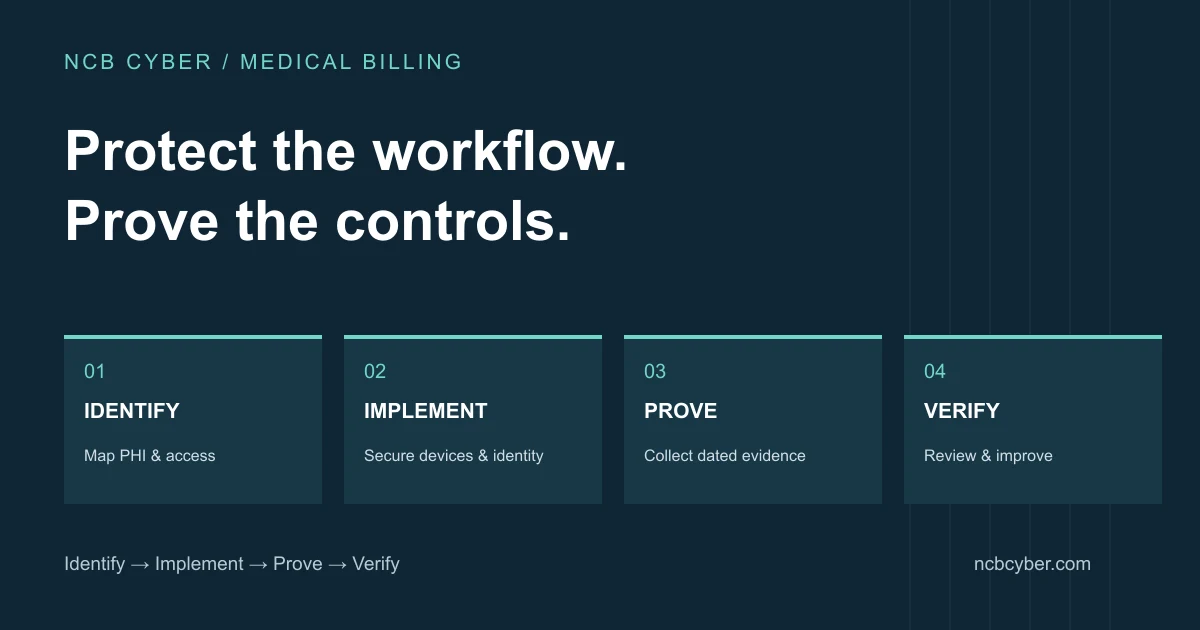
Identify → Implement → Prove → Verify
We identify the risk, implement the control, produce the evidence, and continuously verify it.
Map data, devices, accounts and vendors. Agree priorities through a risk assessment and compliance gap review.
Use CyberGuard to implement scoped endpoint, identity, email, encryption and configuration improvements.
Document settings, approvals, exceptions, policies and completed remediation in a dated evidence register.
Review control coverage, access changes and exceptions, then report progress and next decisions.
A scoped review of workflows, access, devices and vendors, with a prioritized risk register, compliance gaps and a practical remediation plan.
Endpoint protection, device management and patching, identity and MFA, email security, encryption, secure configuration and incident readiness—scoped to your environment.
Control-coverage reviews, evidence maintenance, exception tracking, policy ownership and management reporting. Add security leadership as your organization grows.
Explore assessments · Explore CyberGuard · Compliance readiness · vCISO services
NCB Cyber can work alongside your existing IT provider. Agree who implements each control, who supplies evidence, who approves exceptions and who responds to alerts. Your MSP may retain helpdesk, infrastructure and application support while NCB Cyber leads the scoped security and readiness work.
| You need to know | Your engagement should make clear |
|---|---|
| What gets assessed? | Users, devices, systems, sites, vendors and workflow boundaries |
| What gets fixed? | Agreed implementation tasks and client/MSP dependencies |
| What do we receive? | Risk register, remediation tracker and dated control evidence |
| What happens next month? | Coverage review, exceptions, progress report and next priorities |
South Florida roots · Remote delivery
We support conversations with billing companies in Fort Lauderdale, Miami, Boca Raton and West Palm Beach, with delivery scope agreed for remote teams and distributed operations. For local organizations, continuity planning should also consider storms, power loss and internet interruptions.
We review publicly observable security signals associated with the business domain you provide, including email-security posture and selected external exposure indicators. You receive prioritized observations and a recommended next step. The snapshot is not a penetration test, full technical audit or compliance determination.
That is not required. We work with the systems and providers already in place and agree which security responsibilities NCB Cyber will own. Platform changes and broader IT projects require separate scope.
The current rule is technology neutral. It includes required and addressable specifications; addressable does not mean optional. We use a risk-based assessment to recommend controls and document decisions, while keeping proposed rules separate from current obligations.
No. We help implement controls and prepare evidence. We do not issue HIPAA certifications or SOC 2 reports. Any independent attestation or specialized legal review is a separate engagement with the appropriate professional.
Yes. Recurring scope can combine CyberGuard control maintenance with evidence reviews and security leadership. Monitoring coverage, response times, tooling, exclusions and responsibilities are defined in the agreement.
See publicly observable risks before giving anyone access to your environment. We review external security signals, email-security posture and exposure indicators, then prioritize what is worth validating internally.
No agents, passwords or system access. On the request form, include the business domain you want reviewed and your approximate employee count. Do not send PHI. Privacy Policy.
HIPAA Risk Analysis for Medical Billing Companies
Remote Medical Billing Security: Access and Device Checklist
Industry briefing · Medical Billing Companies
Billing and revenue-cycle teams handle patient data, payer access and provider-client workflows. The security boundary includes local exports and remote users as well as the billing platform.
Sources reviewed September 10, 2026 · U.S. and Florida focus
Legal · business associates
Billing involving PHI for a covered entity can create business-associate obligations. Confirm the services, agreements and data handled.
Legal · regulated entities
Risk analysis, assigned responsibility, training, incident procedures and contingency planning are central program elements.
Legal · risk based
Review unique identities, authentication, audit controls and transmission security. Current encryption specifications are addressable and require a documented evaluation.
Scope matters. This is a focused overview, not an exhaustive legal checklist. Confirm applicable laws, contracts and exceptions for your organization.
Technical work
People & process
The implementation examples above are recommended scoping priorities. Their mandatory status depends on the applicable rule, contract and risk analysis; they are not all universal legal requirements.
From requirements to working security
Technical work can include endpoint management, EDR, encryption, access and email/domain security. Non-technical support can include risk reviews, policies, vendor oversight, awareness and leadership reporting. Delivery scope, supported systems and responsibilities are agreed before implementation.
Evidence 1
Record the owner, review date, scope and outstanding actions.
Evidence 2
Record the owner, review date, scope and outstanding actions.
Evidence 3
Record the owner, review date, scope and outstanding actions.
No. Services can support your program, but applicability, organizational decisions and evidence still matter. NCB Cyber does not certify HIPAA, FTC compliance or SOC 2, and does not guarantee audit outcomes.
Recommended EDR or endpoint-management tools do not by themselves establish HIPAA compliance. Proposed rule changes are not described as current requirements.
Requirements can change. Review the linked primary sources and your actual obligations before relying on a specific control or deadline.
Get a limited external review of publicly observable risk signals for the business domain you provide. If the findings justify deeper work, we can then scope a Control Review, CyberGuard implementation or compliance engagement.
No obligation. Do not send patient records, customer files or passwords. Privacy Policy
For growing billing organizations, often around 30–200 employees, connect technical controls to requirements and oversight through CyberGuard, Cyber Compliance and Virtual CISO. Work alongside your existing IT team or MSP with defined responsibilities.
Request a Cybersecurity Control Review → · Healthcare cybersecurity hub